

WAZIRI IDA’S TREATISE ON THE STATE OF THE NATION: “A Statesman’s Case For Reform With A Human Face”
By M K Ilyasu.
Opening:
A proposition that ongoing Govt agenda gives people cognitive capacity while traditional title holders like Waziri should provide sustainable direction.

This was my view when I reflected on Waziri Ida’s treatise on the “State of the Nation” which he captioned “When the Road is Hard, the Destination still Matters: “A Statesman’s Case for Reform with a Human Face”.
Can the ongoing political reform transform our civic responsibilities into a more powerful instrument of social accountability? I would say YES.
Can the Traditional Institution transform itself into a more sophisticated instrument of political sensitization and mobilization by gathering community concerns through
civic education;
mobilizing citizens for development;
mediating local disputes;
encouraging peaceful political participation and
identifying emerging security and social tensions? YES. It can!!
This is where my thesis begins because Waziri’s treatise on our political spectrum should be conceptualized around three fundamental questions, two of which he dealt with, thus; State Power and Economy, BUT, Identity or Culture if you may, was left largely untreated.
The relationship of this triadic has very often help explain political tensions visible in many societies today, including debates about global insecurities, raising agitations for separation, kidnappings, banditry and terrorism due to lack of synergy and economic inequality.
Identity politics therefore plays a large role in ethnic, regional, and religious balances which to a large extent influence political coalitions and social order.

Undoubtedly, our politicians are economically market-oriented while simultaneously favouring extensive state authority and appealing strongly to communal or national identity.
If I may take us back, our Federal Constitution start with “We”.
Who are the people that constitute the political “WE”?
What should constitute the political community, individual citizenship, ethnic/community identity, or national identity?”
Political belonging is understood substantially through ethnic, religious, linguistic, regional, or traditional communities.
The principle becomes:
“I belong politically because I belong to a particular community.”
This can provide people with cultural security, communal representation, protection for minorities, CONTINUITY WITH TRADITIONAL INSTITUTIONS.
Moving into greater question on how the “Traditional Institution”can be transformed into a more sophisticated instrument of political sensitization and mobilization.
What do we expect from our “Traditional Establishment” in the ongoing political arrangement? Does “Traditional Institution” have any serious role to play, considering that members have right to belong to different political orientation without jeopardizing the interest of followers?
More importantly, political behaviour is mediated by institutions and social circumstances. Participation and Culture may shape a person’s political view, but whether that view becomes political support, protest, accommodation, withdrawal or mobilization depends substantially on the political environment.
In a society where Traditional institutions are trusted, sensitization may encourage political participation. However, where the institution is perceived as corrupt or unresponsive, the same Traditional Institution may produce political alienation.
Similarly, the manner of using religion may become a force for social solidarity in one context and a basis for political polarization in another.
The deeper relationship, therefore, may be expressed as:
Culture shapes consciousness; religion shapes moral interpretation; social institutions like “Traditional” should be seen to shape collective behaviour; and political participation should determine the direction in which these forces are expressed peacefully.
This also suggests that the most important question is not whether culture makes people more or less obedient. It is whether it transforms the manner in which political convictions are translated into social and political conduct.
Must I leave the followings for reaction.
The challenge is therefore to encourage traditional authority, to democratize its social function. In that sense, the traditional institution becomes a school of citizenship. Traditional institutions must continue to provide a continuous connection between government and communities.
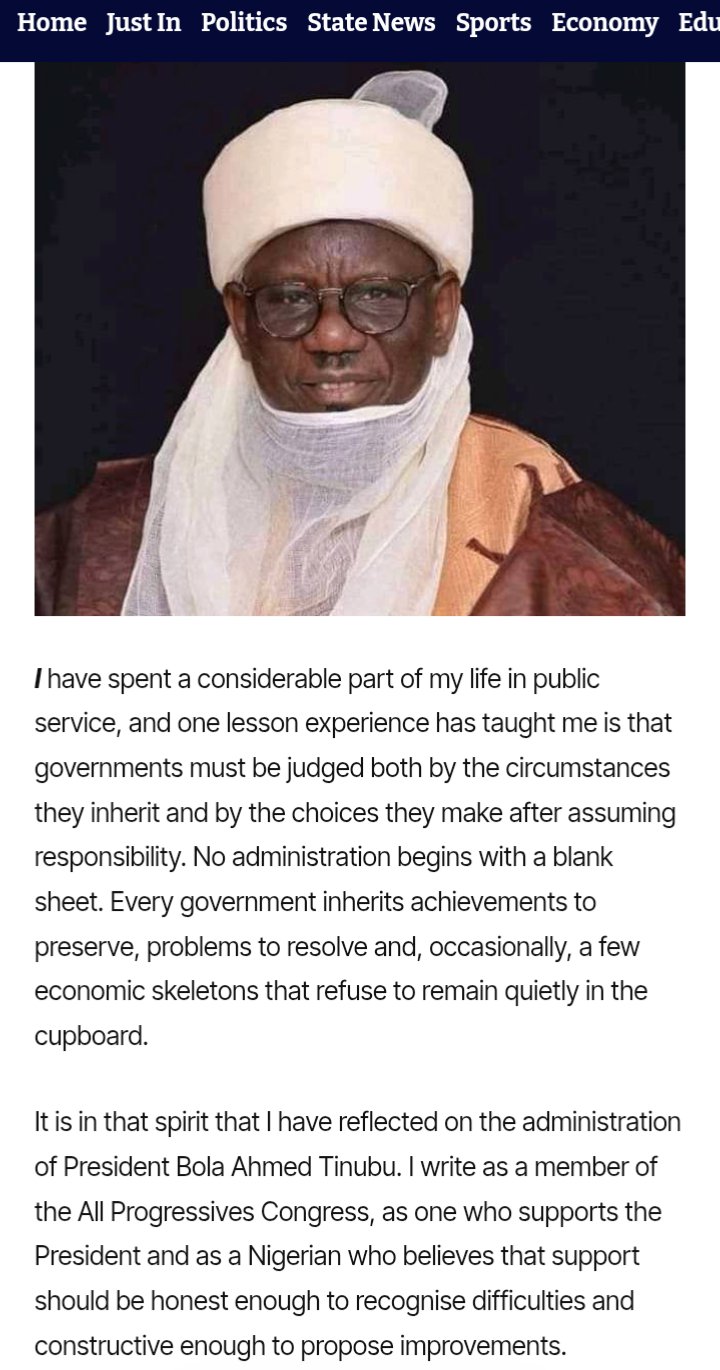
A traditional title holder like Waziri Ida has tasted lots. He was a Banker, Katsina State Commissioner of Finance, retired Federal Permanent Secretary, Politician (served as Senator of the FRN), Scholar with a PhD degree and presently Wazirin Katsina. It is important to note that our Culture that is further reinforced by Islamic traditions cannot simply be described in theocratic versions of Western social-contract theory.
My approach may seem to oversimplify the relationship between govt reform agenda, traditional counseling and political behaviour.
Experienced people like Waziri should be seen to
be communicating government policies;
gathering community concerns; involve in civic education; mobilizing our citizens for development; mediating local disputes; encouraging peaceful political participation as well as identifying emerging security and social tensions.
I am encouraged to wish for the best, where our people would benefit from the observations and interventions of our seasoned traditional titled holders like Waziri in the ongoing govt reform agenda.

This therefore calls for more discourse on the ongoing govt reforms from our Emirate custodians with specific actions plans for the future of the communities as well as the integrity of the Emirate systems.
M K Ilyasu writes from Kaduna Nigeria
28th September 2026